
Urbanism in the melancholy future
- The new cities of the Ambergris Republics are elegant and enviable monuments to newfound prosperity. However, even the most patriotic of the whaler-capitalists must admit that the greatest of their cities pales in comparison to the ruined metropoles of the old world.
- Volcker, that grey-eyed man of destiny, proudly proclaims that he will build a city to rival those of his wealthy patrons. Yet, for now at least, Fort Virtue is little more than a blockhouse atop the ashes of the Cobalt King’s citadel.
- It is said that there were once many more people upon the face of the earth. What else could explain the size of Kapitol? Were every single man, dwarf, and goblin beneath the glowing moon to leave their homes and take up residence in its ruined palaces and overgrown plazas then one could still wander for days through empty streets without encountering a single living creature.
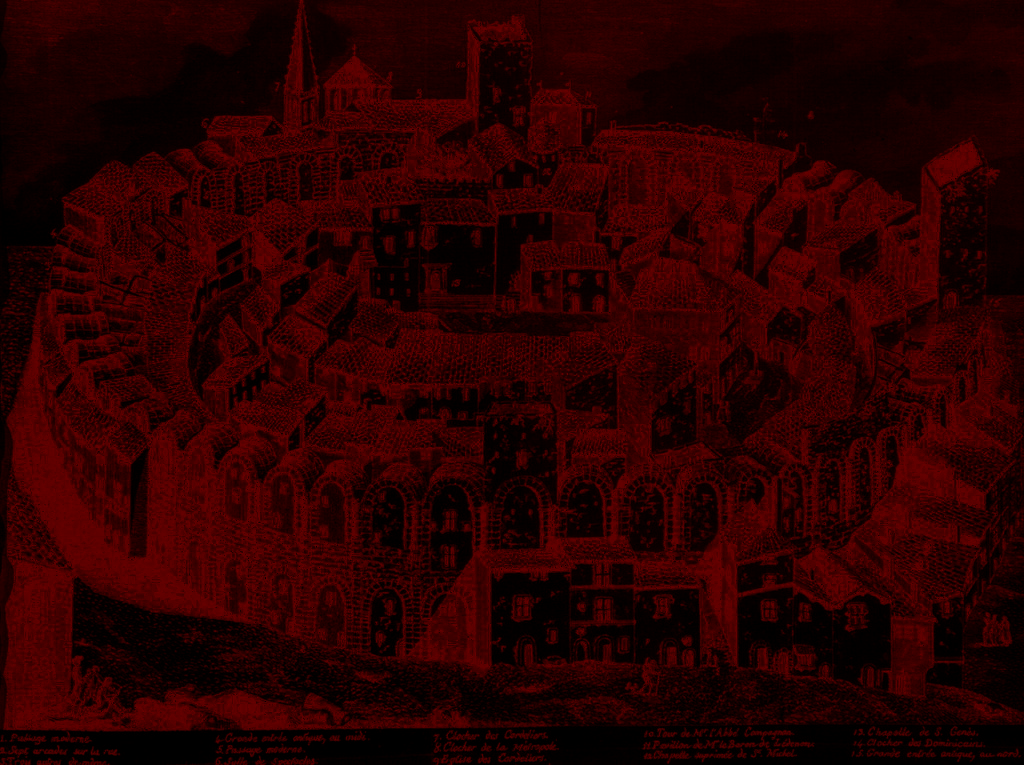
- To travel in Kapitol is to know the sublime. Around every corner lurks some great glory of a bygone age, raised on an impossible scale; towering granite bastions, delicate marble amphitheatres, crumbling pleasure palaces, elegant rotundas, villas that scrape the sky. These ancient achievements mock the meagre accomplishments of our lesser epoch.
- There are dozens of known settlements within Kapitol (many more remain undiscovered). The village of Artigiane consists of a dozen thatched cottages built beneath an enormous frescoed wall (itself the remnant of a far larger structure, now mostly crumbled into dust). A new religion has formed around the figures depicted in the chipped plaster. Each inhabitant of Artigiane proudly announces themselves as a ‘devotee of the blonde-haired child’, a ‘follower of the halo-wearing giant’ or a ‘scion of the circling vultures’. A few beyond the village have been converted to the new faith and the new pilgrimage trade has enriched the formerly impoverished villagers.
- The inhabitants of Latore are cursed by geography. Raiders (human and otherwise) are extremely active on the busy trade route that follows the miles-long boulevard known as the Street of the Yellow Horse. The settlement’s proximity to the water and to the abyssal cistern invites attack by river pirates and goblin outcasts alike. Two decades ago, the villagers, having barely survived a brutal labour-raid by ambitious Cordwain Company agents, relocated their homes to the roof of a long-abandoned tower. New Latore can only be reached by an ascent through twenty-three storeys of crumbing stone stairs. Enemies of the Latorians can expect cunning booby-traps and constant armed resistance as they attempt the climb.
- Tranquillity is a wealthy trading entrepot built atop a grass-covered palazzo. Its success comes not just from its location at a confluence of trade routes. At the centre of the settlement is an enormous marble statue of a beautiful maiden holding a lyre and a basket of fruit. Nobody within a one-mile radius of the effigy can commit an act of aggression. Indeed, even the thought of violence is impossible while under the effects of the statue’s strange aura.
- Some say the city’s original ruler yet lives, somewhere within the bowels of the square-mile palace at the heart of the ruined metropolis. They say he regards the city’s scattered inhabitants as squatters and gathers his power in preparation for a bloody purge of the interlopers who trespass upon his ancient domain.
 Osraige Press
Leave a comment